
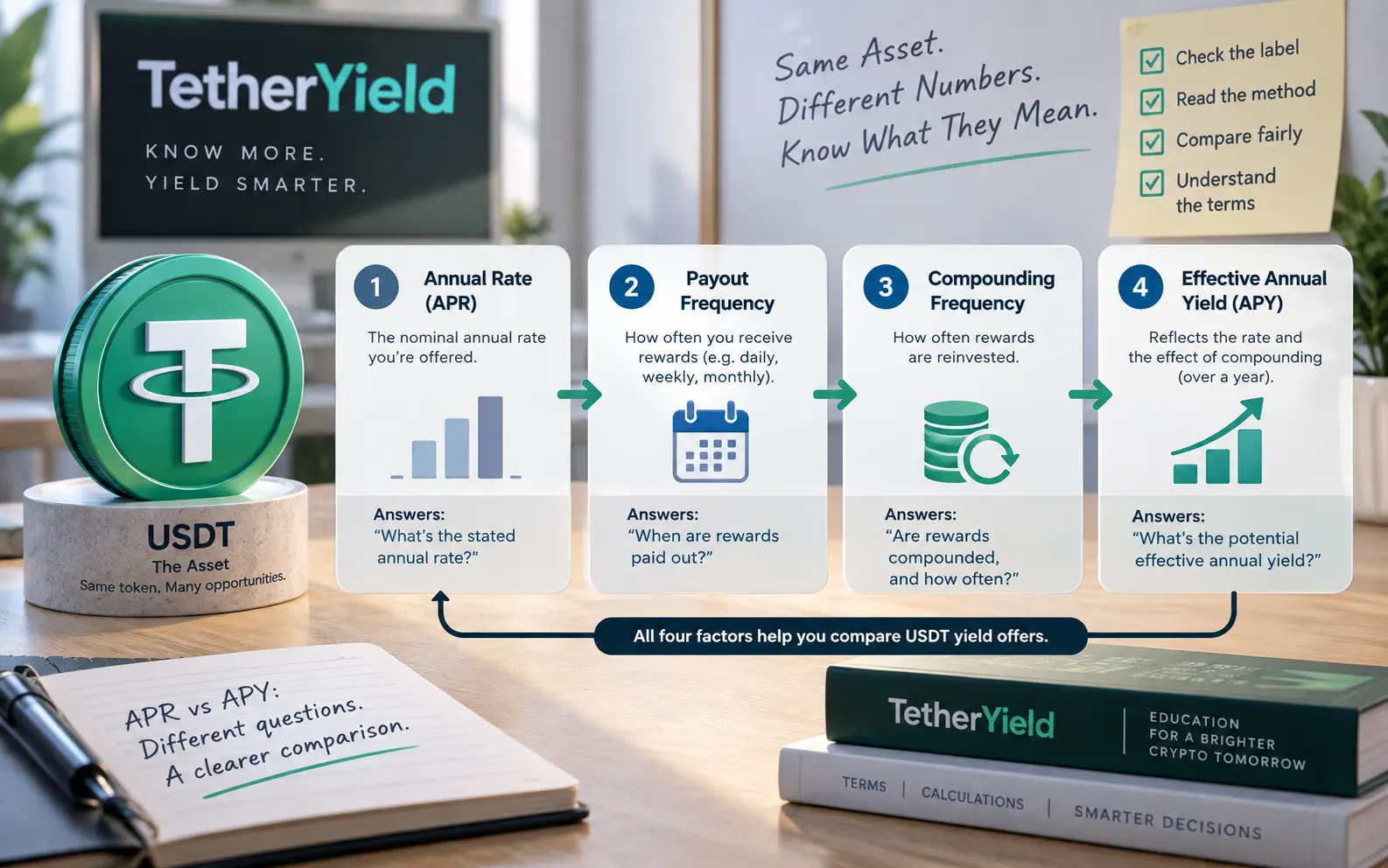
APR and APY answer different questions
When two USDT yield offers display annual percentages, the numbers are only comparable if you understand what each one assumes. In consumer deposit rules, APY is an annualized measure that reflects both an interest rate and the frequency of compounding. Crypto and yield products do not always use APR and APY with the same regulatory definitions, so treat the label as a starting point and read the provider's calculation method.
A practical shortcut is to separate three layers. First is the nominal or quoted annual rate. Second is payout frequency: how often rewards become available or are credited. Third is compounding: whether credited rewards are automatically or manually added to the balance that earns the next reward. APY tries to express the effective annual result when compounding assumptions are included; a nominal annual rate normally does not.
- Quoted annual rate: the base percentage before compounding assumptions.
- Payout frequency: how often rewards are credited or made available.
- Compounding frequency: how often earned rewards actually join the next earning base.
- Effective annual yield: the mathematical annualized result after the compounding assumption.

A 1,000 USDT example shows the compounding gap
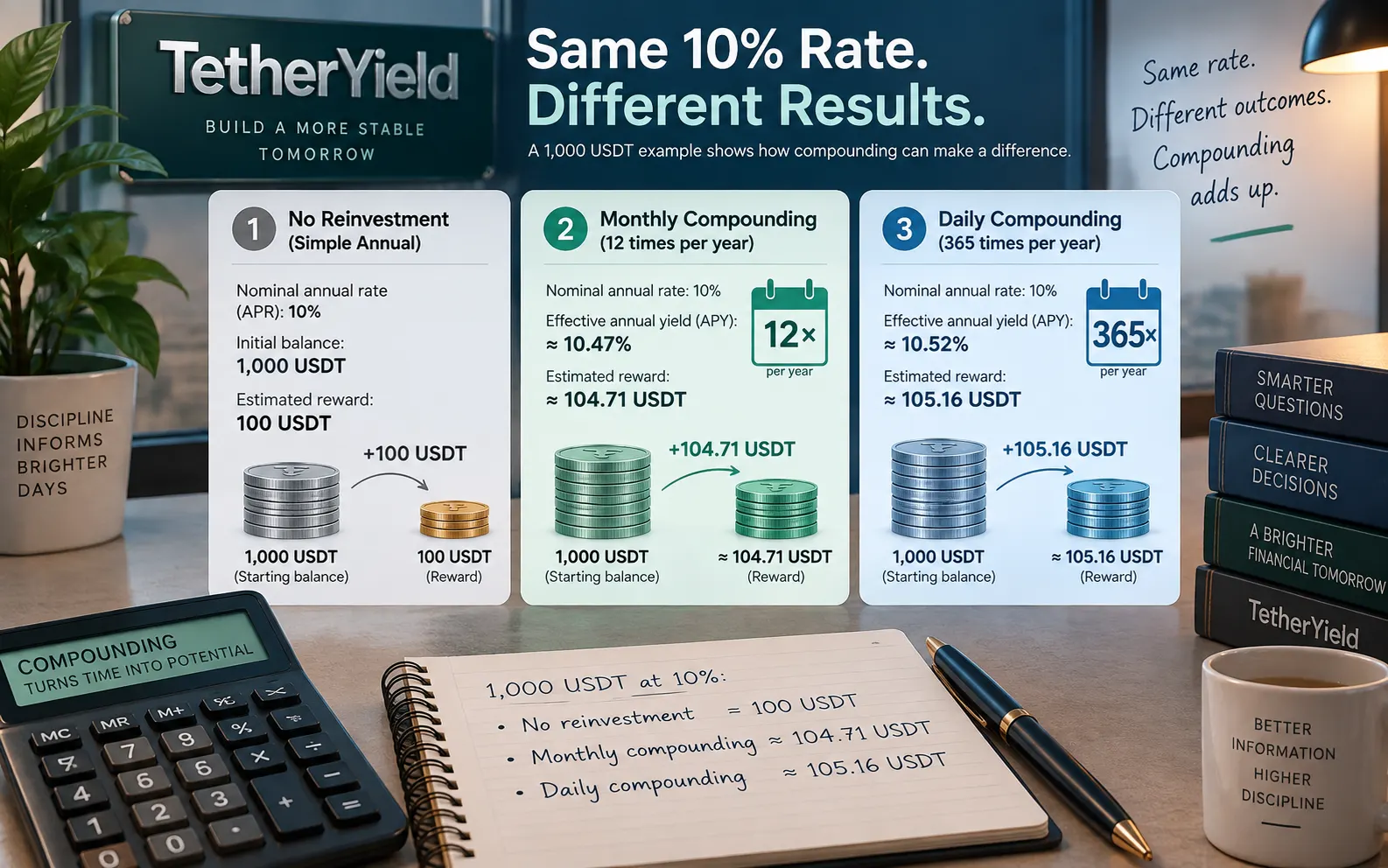
Use a hypothetical 1,000 USDT balance and a 10% nominal annual rate. If nothing is reinvested during the year, the simple annual estimate is 100 USDT. If the same nominal rate compounds monthly, the mathematical effective annual yield is about 10.47%, or about 104.71 USDT on 1,000 USDT. If it compounds daily, the mathematical effective annual yield is about 10.52%, or about 105.16 USDT.
The point is not that daily compounding automatically makes a plan better. The difference in this example is only about 5.16 USDT versus simple annual math, and the calculation is valid only if the rate stays unchanged, rewards are reinvested on schedule, there are no deductions, and the full balance remains eligible. Real yield products can have variable rates, eligibility rules, capacity limits, fees or withdrawal constraints that change the outcome.
- Start with the nominal annual rate as a decimal: 10% = 0.10.
- For n compounding periods, use effective yield = (1 + rate / n)^n - 1.
- Multiply the effective yield by the eligible principal to get a before-fee estimate.
- Then adjust for the actual product rules instead of treating the formula as a guaranteed payout.
| Hypothetical treatment | Effective annual rate | Estimated annual reward on 1,000 USDT |
|---|---|---|
| No reinvestment during the year | 10.00% | 100.00 USDT |
| Monthly compounding | 10.47% | 104.71 USDT |
| Daily compounding | 10.52% | 105.16 USDT |
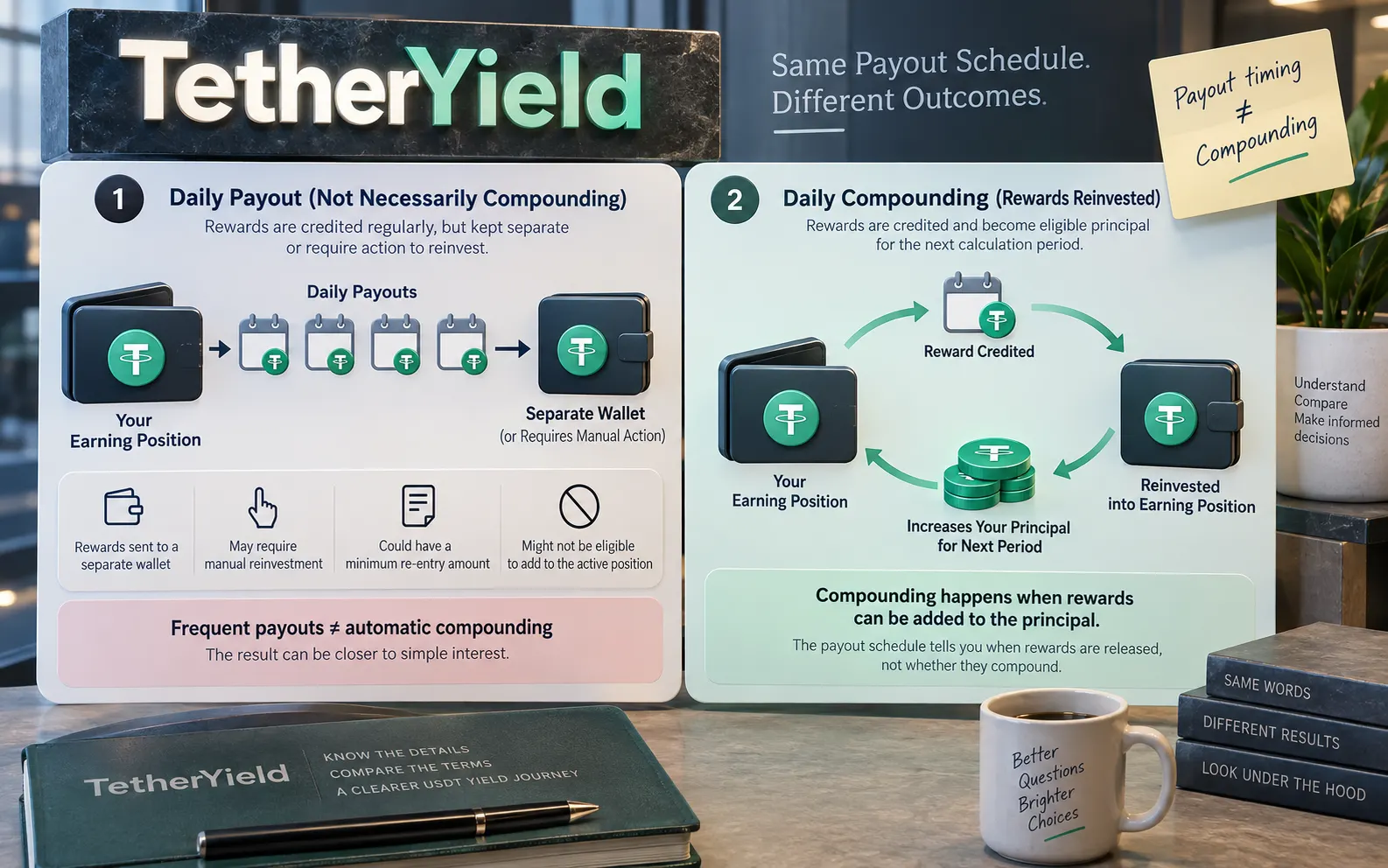
Daily payout does not necessarily mean daily compounding
A common comparison error is to see “daily payout” and assume the displayed reward compounds every day. A payout schedule only tells you when a reward is credited or released. For daily compounding to occur, that reward must also become eligible principal for the next calculation period. If rewards sit in a separate wallet, require a manual action, have a minimum re-entry amount, or cannot be added to the active position, the economic result can be closer to simple interest than to a daily-compounded APY.
The reverse matters too. A product may display an APY based on automatic reinvestment while a user plans to withdraw rewards as they arrive. In that case, the user's realized path will differ from the displayed compounding scenario. Compare the plan to your intended behavior, not just to the provider's idealized annualized example.
- Ask whether reinvestment is automatic, optional or unavailable.
- Check whether credited rewards are immediately eligible to earn again.
- Look for minimum amounts, timing windows or capacity limits on reinvestment.
- If you plan to withdraw rewards, calculate that cash-flow path separately.
Headline APY is only one line in the net-return calculation
Even correct compounding math is incomplete if it ignores product rules. A lower headline rate with straightforward withdrawals and no meaningful deductions can fit a user better than a higher rate with restrictive liquidity or a capital rule the user has not understood. The useful comparison is therefore not “which APY is highest?” but “what can I reasonably expect under the exact rules I am willing to accept?”
For TetherYield plans, review the current plan page and risk disclosure before funding because plan terms, availability and estimates can change. When a plan does not return capital in the same way as a conventional deposit, an annualized APY comparison may be the wrong lens entirely; a payout schedule, breakeven point and net return over the actual term can be more informative.
- Fees and deductions: joining, withdrawal, network or other applicable costs.
- Liquidity: lockup period, early-close rules and when funds become available.
- Capital rule: whether and when principal is returned under the plan terms.
- Rate variability: whether the displayed rate can change during the relevant period.
- Eligibility and capacity: minimums, maximums, batch limits or other conditions.
Use a five-line worksheet before comparing two plans
A simple worksheet prevents rate labels from dominating the decision. Write down the rate basis, the actual reinvestment behavior, expected deductions, liquidity rule and capital treatment for each plan. Only after those rows are clear should you calculate a net estimate for the time you actually expect to keep funds in the plan.
For a fixed-term comparison, calculate both plans over the same holding period and principal. For an open-ended plan, avoid projecting a one-year compounded result unless the plan and your intended behavior genuinely support that assumption. If two offers use different definitions of APR or APY, normalize them into the same scenario rather than comparing the displayed percentages directly.
- Choose one principal amount and one holding period.
- Convert the quoted rate into the plan's actual payout and compounding method.
- Subtract expected fees or deductions that apply to your scenario.
- Account for lockup, early-close and capital-return rules.
- Compare the resulting cash flows and risks, not just the final percentage.
| Comparison row | Plan A | Plan B | Why it matters |
|---|---|---|---|
| Rate basis | APR / APY / other | APR / APY / other | Labels may use different assumptions. |
| Reinvestment | Automatic / manual / none | Automatic / manual / none | Determines whether compounding is realistic. |
| Fees and deductions | List expected costs | List expected costs | Headline yield is not net yield. |
| Liquidity | Lockup and exit rule | Lockup and exit rule | Affects access to funds and flexibility. |
| Capital treatment | Return rule and timing | Return rule and timing | Changes the meaning of any percentage comparison. |

The better rate is the one you can explain line by line
APR and APY are useful shortcuts, but neither replaces the underlying cash-flow rules. A sound USDT yield comparison should let you explain where the percentage comes from, whether compounding really occurs, when rewards become available, what costs can reduce them, and what happens to principal under the plan.
Before funding, save or review the current plan terms and run a conservative scenario as well as the headline scenario. If any input is unclear—especially the rate basis, reinvestment, withdrawal timing or capital treatment—treat the estimate as incomplete. Reward estimates are planning tools, not guaranteed returns.
- Can I reproduce the provider's annualized number from the stated assumptions?
- Does my actual withdrawal or reinvestment behavior match those assumptions?
- What happens if the rate changes or I exit earlier than planned?
- Which costs or capital rules could make my realized result lower than the headline estimate?