USDT is the asset; the network is the route
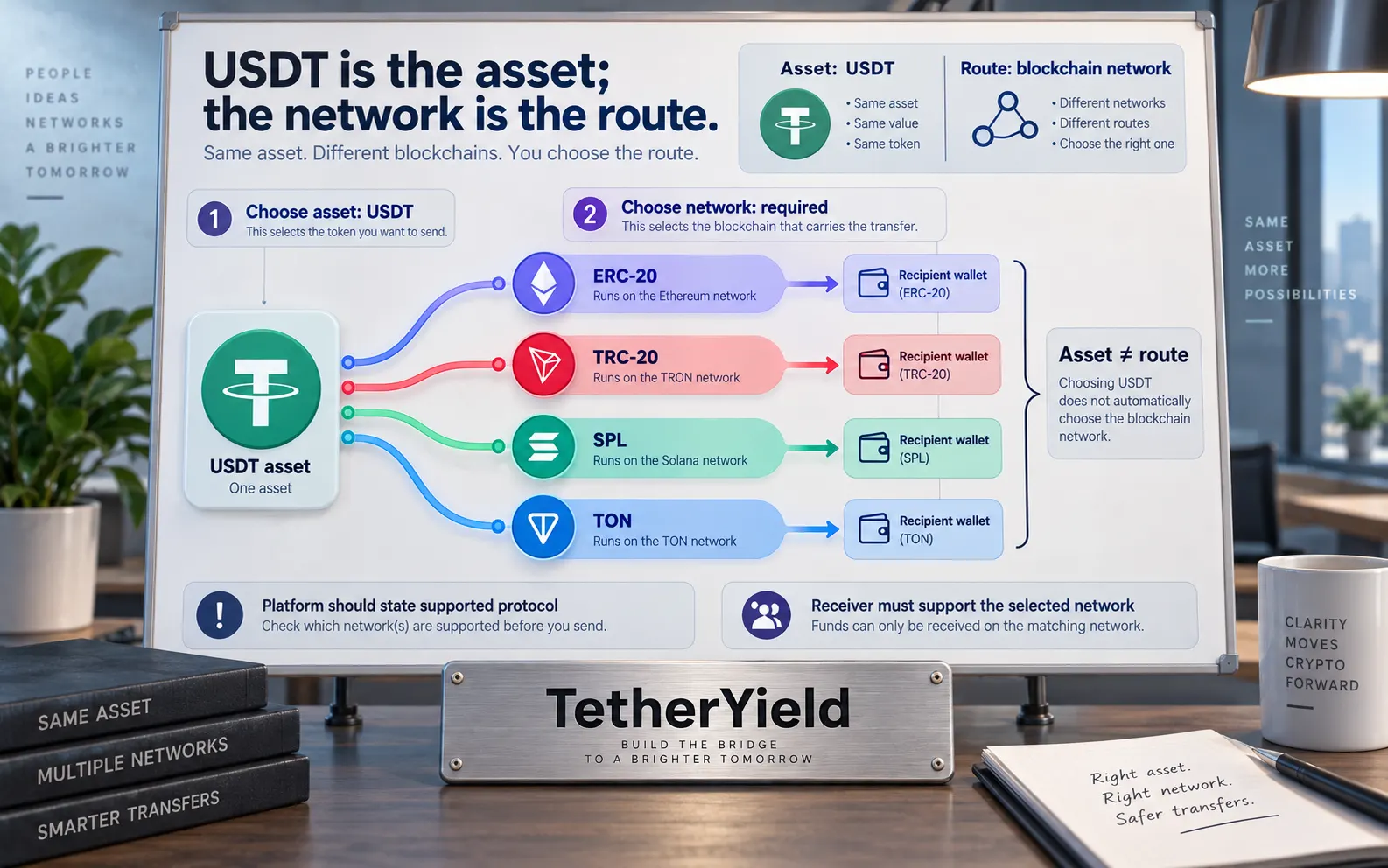
USD₮ is issued on multiple blockchains. Tether's current integration guidance lists several supported protocols and asks platforms to state clearly which protocols they support. That distinction matters to a user because choosing USDT does not, by itself, choose the blockchain that will carry the transfer.
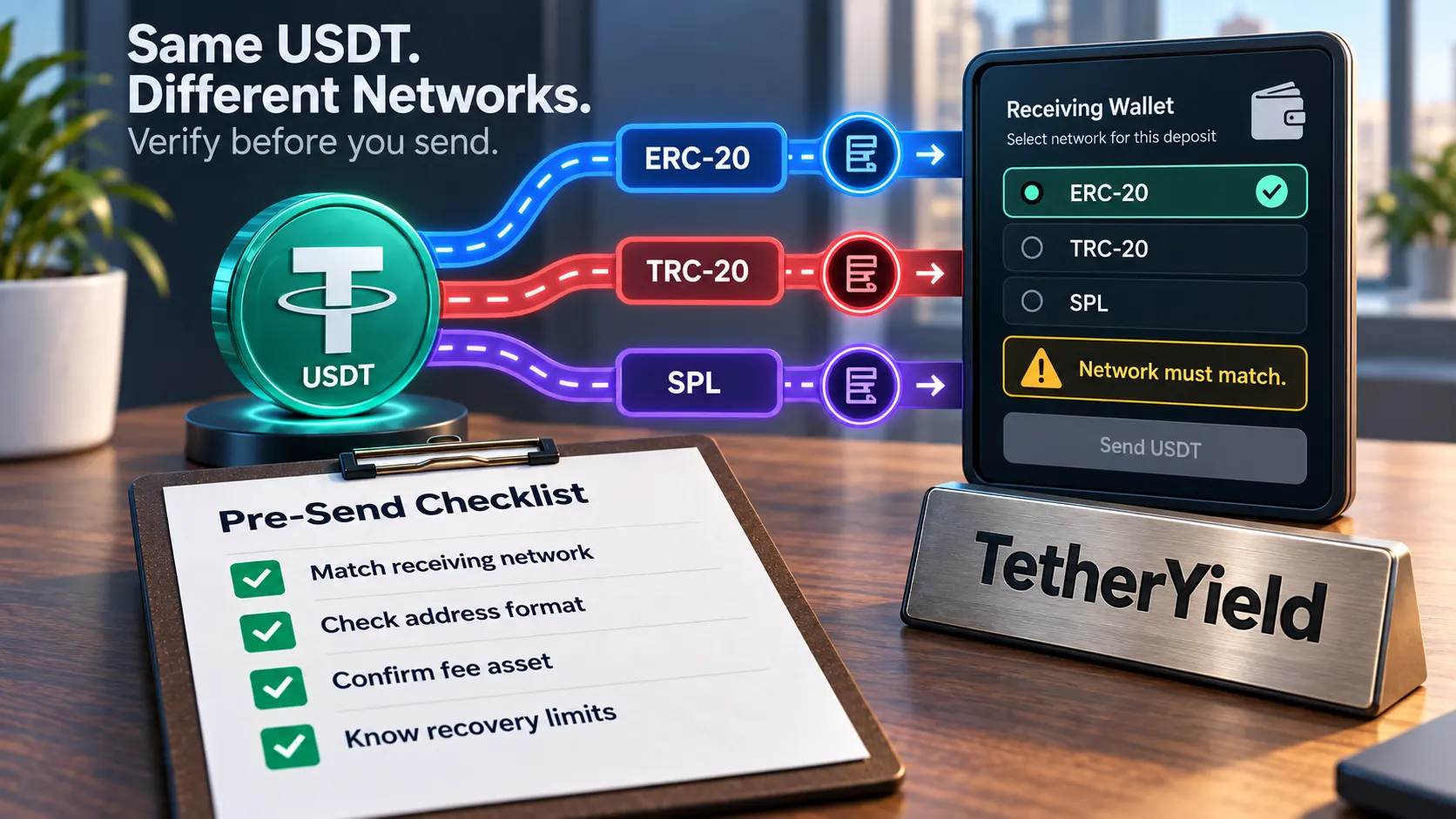
A useful mental model is to verify three separate things before sending: the asset is USDT, the sending network exactly matches the receiving network, and the destination belongs to the service or wallet you intend to fund. If any one of those three is uncertain, do not treat a familiar ticker or a plausible-looking address as confirmation.
- Asset: USDT, not another stablecoin or similarly named token.
- Network: the exact blockchain named by the receiving service.
- Destination: the address and any additional destination field supplied for that network.
Start with the receiving side, not the cheapest withdrawal option
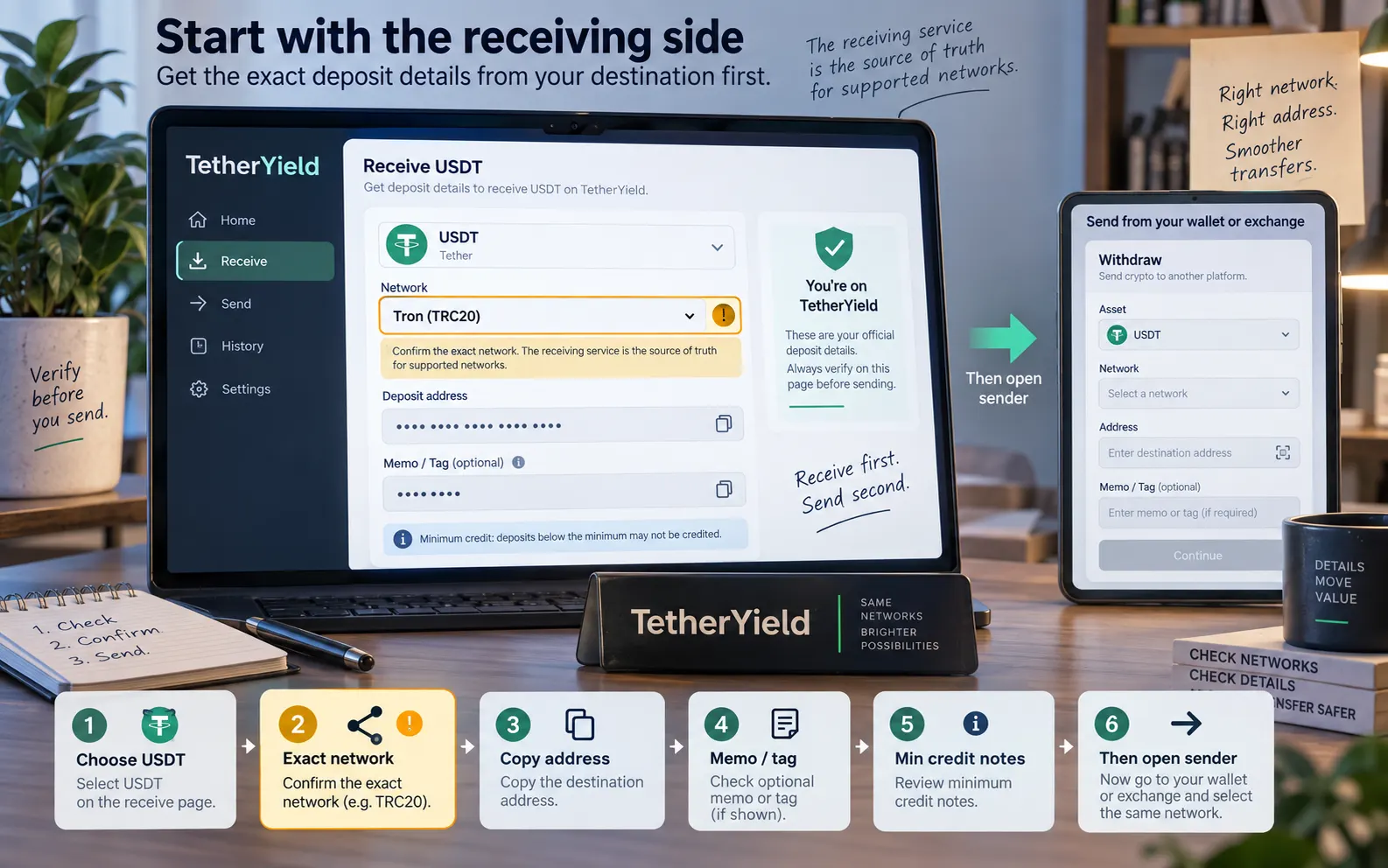
Open the deposit or receive screen at the destination first. The receiving service is the source of truth for the networks it is prepared to recognize for that account. Record the exact network label before you open the sender's withdrawal menu.
This order prevents a common decision error: selecting a network at the sender because it looks faster or cheaper and only then checking whether the destination accepts it. A lower fee is irrelevant if the receiving system does not support that transfer path.
- Choose USDT on the receiving service.
- Copy or record the exact network name shown there.
- Copy the destination address from that same network screen.
- If the service explicitly shows a memo, tag or other destination field, preserve it exactly.
- Check any minimum-deposit or crediting notes shown by the receiving service before sending.
Match the sending network exactly
Now return to the sending wallet or platform and choose the withdrawal network. The label should match the receiving network, not merely look related. Tether supports tokens on multiple protocols, and platform support can differ even when the asset symbol remains USDT.
Do not infer compatibility from address appearance alone. Some ecosystems can have related or similar-looking address representations, while the asset still lives on a specific blockchain and token contract. The receiving service's named network is a stronger control than visual guesswork.
- Re-read the destination network immediately before confirming the withdrawal.
- Confirm the sender is withdrawing USDT on that same network.
- If either service has paused the network, wait rather than substituting another chain without explicit support.
Fees belong to the route, not to USDT itself
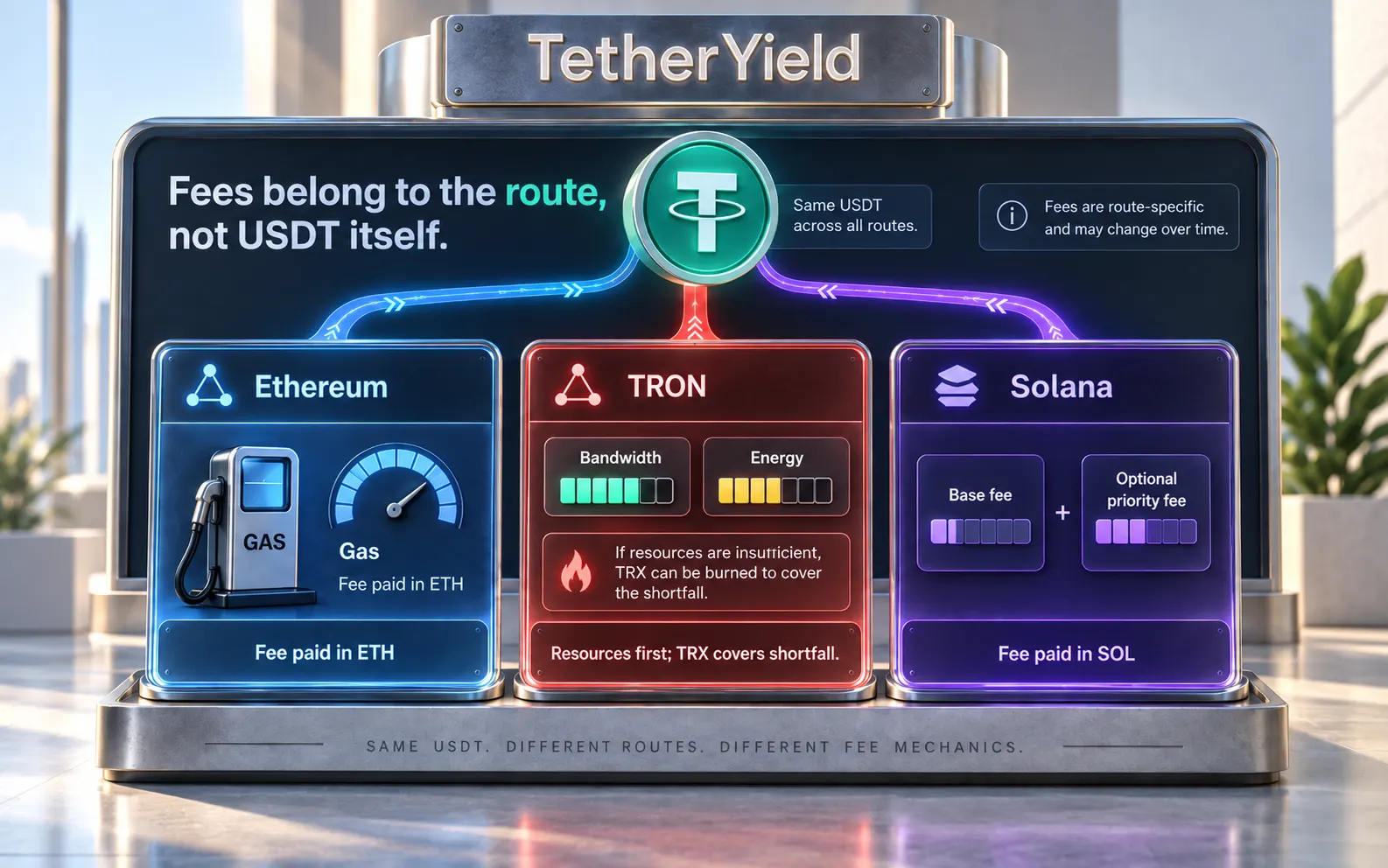
Different networks charge for transactions in different ways. Ethereum uses gas paid in ETH. TRON meters transactions through Bandwidth and Energy; when resources are insufficient, TRX can be burned to cover the shortfall. Solana transactions require a fee paid in SOL, with a base fee and an optional prioritization component.
Those are network mechanics, not a permanent ranking of which route is cheapest. A wallet or exchange can also charge its own withdrawal fee, and network conditions can change. Compare the amount you expect the recipient to receive, the service fee, the required native fee asset and the destination's support before deciding.
| Network example | Native fee mechanism | Pre-send question |
|---|---|---|
| Ethereum | Gas paid in ETH | Do I have enough ETH for the transaction and is Ethereum supported at the destination? |
| TRON | Bandwidth/Energy, with TRX used when resources are insufficient | Does the sender have the required resources or TRX, and is TRON supported at the destination? |
| Solana | Transaction fee paid in SOL | Do I have enough SOL for fees and is Solana supported at the destination? |
Use address format as a warning signal, not as proof
Address format can help you notice an obvious mismatch, but it should not be your network selector. Ethereum accounts are represented as 20-byte addresses with a 0x prefix. TRON wallets commonly show Base58Check addresses beginning with T, and TRON's raw address construction is related to the same underlying 20-byte public-key-derived value used by Ethereum. Solana accounts use 32-byte addresses typically displayed in base58.
The lesson is not to memorize every format. It is to use an unexpected format as a reason to stop and re-check, while still relying on the receiving service's explicit network label and destination instructions for the final decision.
- Unexpected address format: stop and verify.
- Expected-looking address format: still verify the network.
- Never change or convert an address manually unless the receiving service explicitly instructs you to do so.
A small test transfer can reduce operational uncertainty
For a meaningful transfer, a small test can confirm that the route you selected is recognized by the receiving service before you send the remainder. A test does not make blockchain risk disappear, but it can catch a copied-address error, an unsupported route or a misunderstanding about how the destination credits the deposit.
A test is only useful when it meets the destination's minimum-credit rules and when fixed withdrawal fees do not make it impractical. After the test is credited, verify the asset, network and destination record rather than assuming that an on-chain success alone proves the receiving service has credited the account correctly.
- Send only an amount that satisfies the destination's stated minimums.
- Wait for the receiving service to recognize and credit it.
- Confirm the credited asset and network record.
- Only then consider sending the remaining amount using the same verified route.
If a transfer goes wrong, stop and preserve the evidence
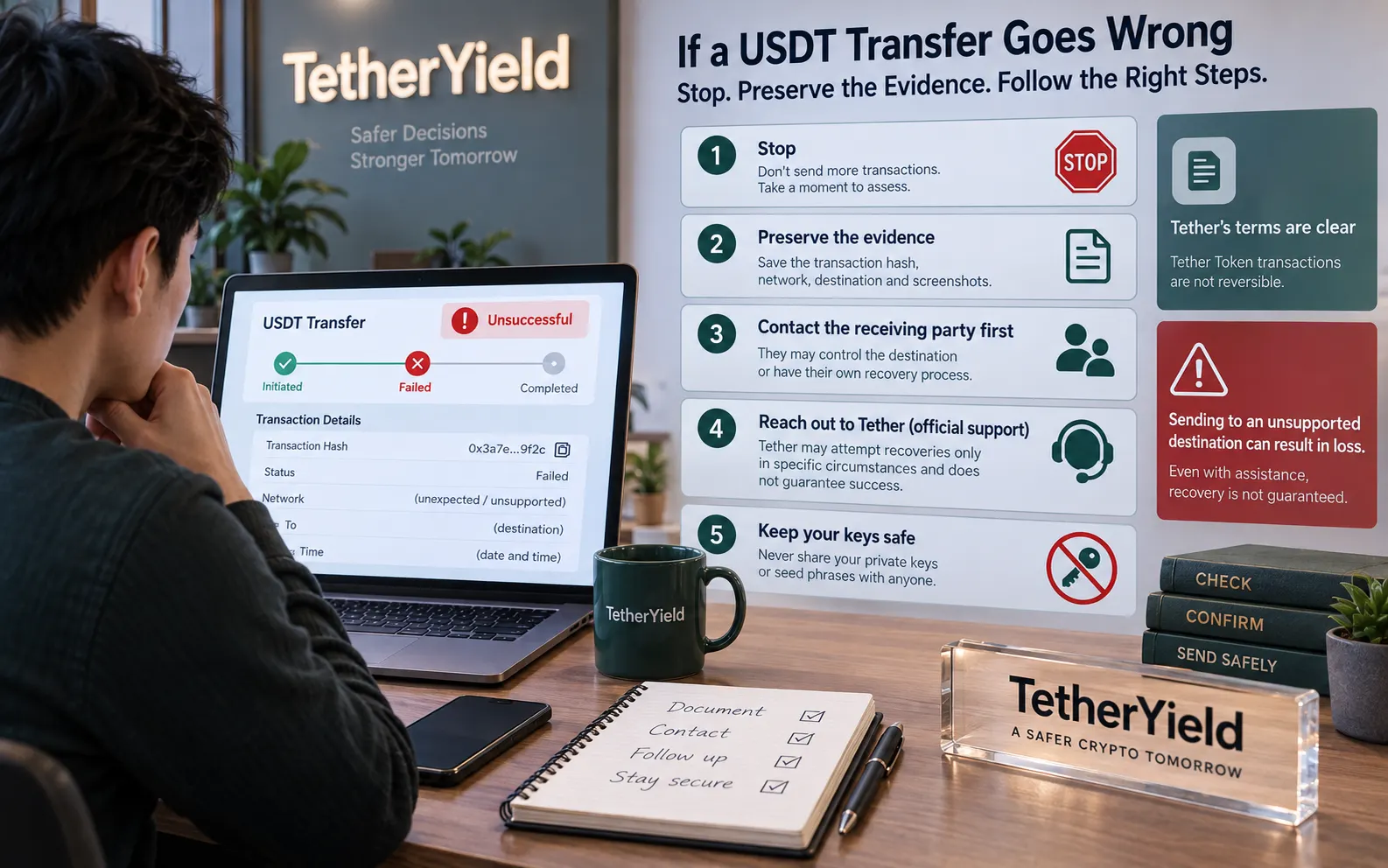
Tether's terms state that Tether Token transactions are not reversible, and its recovery guidance warns that sending tokens to an unsupported destination can result in loss. Tether may attempt recoveries only in specific circumstances and does not guarantee success. The receiving party is often the first place to ask for help because it may control the destination or have its own recovery process.
Do not send another transfer to the same route in an attempt to fix the first one. Save the transaction hash, sending and receiving addresses, network name, asset, timestamp and any screenshots or support references. Contact the receiving service through its official channel, then follow any applicable issuer or wallet recovery process. Be cautious of anyone promising guaranteed recovery in exchange for a private key or seed phrase.
- Stop additional transfers on the uncertain route.
- Preserve the transaction hash and destination details.
- Contact the receiving party through official support channels.
- Treat recovery as case-specific, not guaranteed.